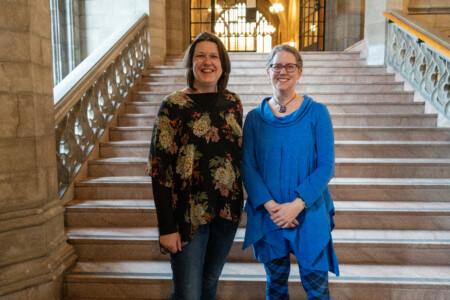
 The Rev. Dr. Sarah Travis and Dr. Laura Alary are on a mission to bridge that gap through their upcoming book, The Body at Play: Trauma and the Promise of Playful Worship. Inspired by a grant from the Calvin Institute for Christian Worship, this dynamic duo explores the intersection of playful worship, trauma, and the human experience.
Reflecting on the inception of the book, Sarah comments, “I applied for this grant without having a great deal of knowledge about play or what playful worship might be. My goal became to just explore and wonder about play and worship.” At the time, she was serving in a small church, seeking ways to revitalize its spiritual practices. “Playful worship seemed to intersect with their sadness in an important way,” she adds, emphasizing the transformative potential of integrating play into worship settings.
As the project evolved, Sarah recognized the need for a collaborator who could bring practical experience to the theoretical foundation. “What led to that decision to add Laura as a co-author was realizing I did not have the skills to do this by myself,” she explains. “I was very good at thinking about play and trauma from an intellectual perspective, but the actual realities of play are very difficult for me.” Laura’s expertise in Children’s Worship and Godly Play made her an ideal partner for this journey.
Laura elaborated on her role, stating, “There’s a strong theoretical basis, but we wanted to help worship leaders translate those ideas into practice.” Her background has equipped her to address the needs of worship leaders, enabling them to engage congregations in new ways. “We were thinking, what would that look like applied to an intergenerational setting?” she muses, envisioning a worship experience that resonates with all ages.
The target audience for their book is clear: worship leaders, laypeople, and ordained ministers charged with planning and coordinating worship services. Sarah envisions a book launch that includes a playful worship service, inviting participants to engage with the concepts introduced in the book. “I would love to see worship leaders actually have a forum to talk about what they’ve tried, what has worked well for them, and what might be tweaked,” adds Laura, highlighting the communal dimension of the book’s mission.
The journey to create this book has involved extensive research. “There’s the theoretical research based on playfulness and trauma, but there was also the anecdotal kind of research,” Sarah explains. “What surprised me the most is that when I engaged congregations with the idea of playful worship, they were actually really excited about it.” She had anticipated resistance, especially from more traditional and reserved congregations. But it seems there is a widespread desire for a more embodied experience of worship. “It turns out,” she says, “that people really want to play.”
Laura notes that playful worship is not necessarily boisterous or geared for outgoing people. “I think the fact that Sarah and I are both introverts,” she explains, “means that we both understand where there is resistance and what it feels like to be asked to do something that makes you uncomfortable.” This understanding informs their approach, allowing them to create a resource that is sensitive to the needs and hesitations of their audience.
“We really took pains to broaden the definition of both play and creativity,” explains Laura. “Some people may have assumptions about what playful worship has to look like,” elaborates Sarah, “and they may be surprised. It’s also not just for children. It’s for adults too, which is a different perspective.” Part of the purpose of the book is to highlight how many of the familiar elements of worship (e.g., scripture, sacraments, the seasons of the church year) already contain playful aspects, and to help worship leaders expand and build upon these.
The embodied nature of play makes it particularly powerful as means of addressing trauma, which is often a deeply physical experience. This is reflected in the working title of the book. “We wanted a title that would reflect the three areas that intersect: worship, trauma, and play,” Laura explains. “The word ‘body’ is significant because it represents the community as the body of Christ, but we also talk a lot in the book about how embodied worship engages us at a deeper level than just the intellectual.”
As they prepare for the completion of the book, both authors emphasize the importance of its practicality. “The ideas and practices are meant to be thought of as a buffet,” Laura says. “It’s not about consuming everything; it’s about trying a few things and figuring out what works in your own setting.” This approach invites worship leaders to adapt the practices to their unique contexts, making the resource flexible and applicable.
As The Body at Play nears completion, Sarah and Laura are excited about the potential impact of their book. Through their exploration of trauma and playful worship, they hope to foster a deeper connection between individuals and their faith communities. In a world so full of heaviness and hurt, they remind us of the vital role of imagination and play in the life of faith and invite congregations to step onto this path toward healing and joy.
Stay tuned for more updates!
